

You don’t need barber jargon to get the haircut you want. Knowing what to say to your barber can feel tricky when you’re unsure of a style’s name or how much length to take off. A vague request like “just a trim” leaves room for guesswork, but a clear description doesn’t have to be complicated.
It’s understandable to want your barber to get it right, and it’s fine to ask questions or share feedback as the cut takes shape. A few details about your preferred look, your routine and what you want to keep can make the conversation easier.
This guide explains how to use photos, simple length references and clear priorities to describe your cut. You’ll also find practical ways to check in during the appointment, so you can speak up and leave with a cut that feels like you.
Key Takeaways
- For what to say to your barber, start with the overall look you want, then describe the length and how much you want changed.
- Break your request into the top, sides, back and neckline to make the details easier to understand.
- Bring photos that show the cut from more than one angle when it’s hard to describe in words.
- If something feels off during the cut, pause, name the detail and ask what adjustment is possible.
- Use a simple script to explain your preferences, whether you’re trying a new look or asking for a tidy-up.
What to say to your barber before the haircut starts
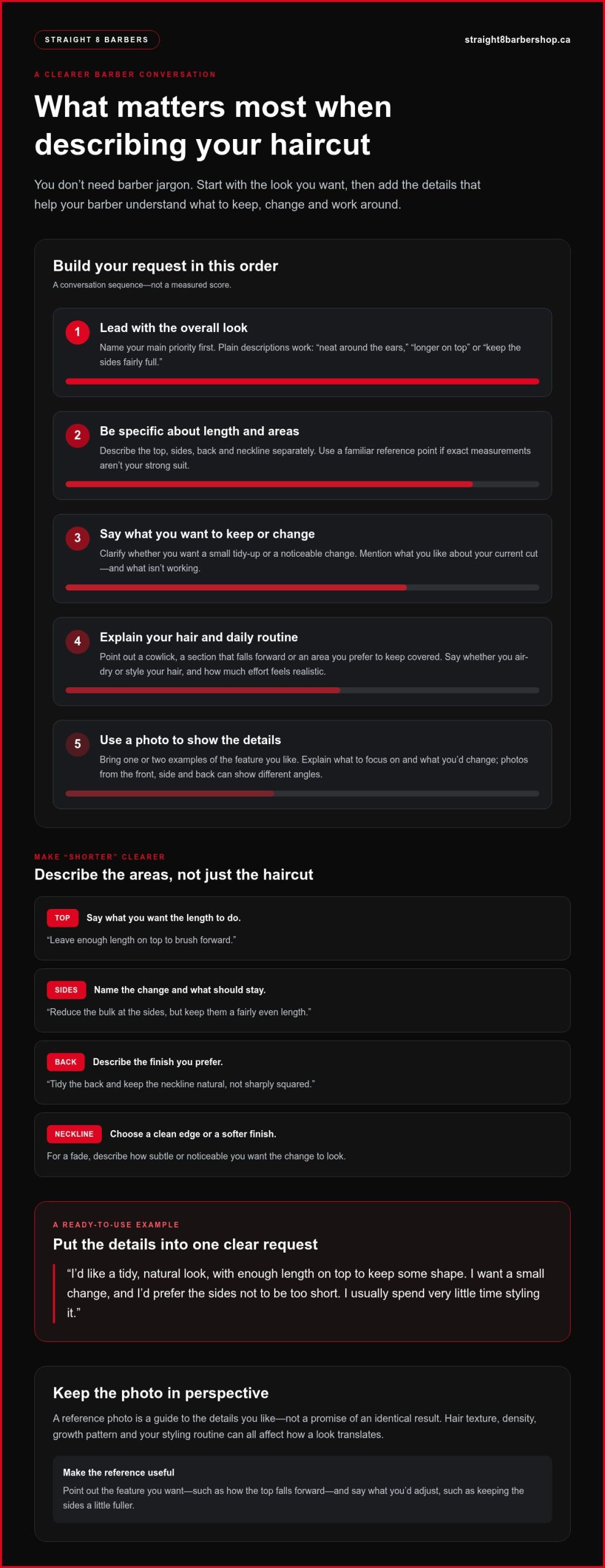
You don’t need to know barber terminology to explain the cut you want. Start with the overall look, the length you’d like to keep and whether you want a small tidy-up or a noticeable change. Speak plainly and mention your main priority first. Your barber can ask follow-up questions to clarify the details.
A clear haircut request pairs a goal with specific details about length, shape and what you want to keep or change.
How to describe the overall haircut you want
Use familiar phrases such as “neat around the ears,” “longer on top” or “keep the sides fairly full.” Then name your main priority before adding smaller preferences. For example: “I’d like to keep some length on top. The main thing is to tidy the sides without taking them too short.” This gives the conversation a useful starting point without requiring a style name.
Be clear about how much change you’re after. If you like your current cut, say you want a small tidy-up. If you’re ready for something different, describe the change you’d like to see. You can also point out what you like or dislike about your hair now: “I like the shape, but the sides feel bulky,” or “I want to keep the length, just clean up the edges.” For background on the history and scope of the barber profession, see this overview.
What to tell your barber about your current hair
Your day-to-day experience with your hair is useful information. Explain what’s easy to manage and what tends to frustrate you. If a cowlick sticks up, a section falls forward or you prefer to keep a particular area covered, mention it before the cut begins. These details can help guide the shape and length.
Be honest about your routine, too. If you usually let your hair air-dry, say so. If you’re comfortable styling it each morning, explain how much time feels realistic. A cut that looks good only with more effort than you want to spend may not suit your routine.
If you’re unsure how to begin, try: “I’d like a tidy, natural look, with enough length on top to keep some shape. I want a small change, and I’d prefer the sides not to be too short. I usually spend very little time styling it.” That’s a clear answer to what to say to your barber. Add or adjust details as the conversation unfolds.
How to explain length, shape and the details of your haircut
“Shorter” can mean something different to each person. Make your request easier to follow by describing the top, sides, back and neckline separately. You don’t need to cover every detail, but naming the areas you want changed helps avoid leaving the shape open to guesswork.
How to talk about length without guessing
Use a familiar reference point if exact measurements aren’t your strong suit. You might say, “Leave enough length on top to brush forward,” or “Take some bulk out of the sides, but keep them covered.” If you know a preferred measurement or clipper guard, share it as a guide. Unsure what a number will look like? Ask your barber to explain how it will affect the cut before starting.
Here are a few ways to turn a broad request into clearer instructions:
| Instead of saying | Try saying |
|---|---|
| “Just shorter.” | “Trim the top enough to tidy it, but leave length to brush forward.” |
| “Take the sides in.” | “Reduce the bulk at the sides, but keep them a fairly even length.” |
| “Clean up the back.” | “Tidy the back and keep the neckline natural, not sharply squared.” |
How to describe the sides, back and neckline
For the sides and back, everyday descriptions work well. “Keep the length even” gives a different direction from “make it gradually shorter towards the bottom.” For the neckline, say whether you prefer a clean, defined edge or a softer, more natural finish. If you want a fade, explain how subtle or noticeable you’d like the change to look rather than relying on the word alone.
This section is about communicating your preferences, not teaching a full haircut or fade technique. Terms such as fades, tapers and layering can be useful, but describe the result you want in your own words too. That gives your barber a practical guide, even if you’re unsure which term best fits the style.
For a haircut at Straight 8 Barbers, a clear rundown of your preferred length and shape helps make the appointment a comfortable, two-way conversation. You can book a haircut at Straight 8 Barbers with your preferences ready to share.
How to use haircut photos and examples your barber can understand
A photo can show details that are hard to put into words, such as the outline around the ears, how the top sits or how the finished cut is styled. It gives you and your barber a shared starting point. A useful reference makes it easier to explain what you like, especially when you’re still figuring out what to say to your barber.
A haircut photo is a guide to the details you like, not a promise of an identical result. Your hair has its own texture, density and growth pattern, and your daily styling routine matters too. The goal is to find a version of the reference that works for you.
Choosing a useful haircut reference photo
Bring one or two examples that share the feature you want most. If it’s the length on top, choose a photo where that’s easy to see. If you like the outline around the ears or the shape at the back, find an image that shows those areas clearly. Photos from the front, side and back can help show how the cut looks from more than one angle.
Give the photo context instead of handing it over without explanation. Try, “I like how the top falls forward here, but I want to keep the sides a little fuller.” That tells your barber what to focus on and what you’d change. A large folder of different cuts can muddy the request, so keep the main goal in view.
How to ask for a version that suits your hair
Hair texture, density and growth direction can affect how a reference translates. A cowlick may change how a section sits, while a different styling routine can affect the finish. The Art of Manliness offers more advice on how to talk to your barber, including sharing preferences about length, neckline and texture.
Ask directly: “How could this look work with my hair type and the way it grows?” You can also say how much time you want to spend styling it. That gives your barber a chance to discuss what’s practical before the cut begins, rather than leaving you to manage an unexpected result at home.
Before the first cut, agree on which parts of the reference you’re keeping and what may need to change. You might love the overall shape but prefer a softer outline or more length at the sides. A quick conversation helps turn the picture into a shared plan.
What to say if you are unsure or want to adjust the cut
You can speak up if you’re uncertain about a detail or want to make a small adjustment. A quick check-in before the finishing work can clear up a misunderstanding while there’s still time to discuss the shape. Keep it calm and specific. You’re sharing what you see and asking what can be done, not criticizing the barber’s work.
Use this simple three-step approach:
- Pause. Ask for a moment before the next step if you need to clarify something.
- Name the detail. Point out the area or length you’re unsure about.
- Ask about the options. Find out what adjustment is possible before asking for more hair to be taken off.
How to speak up when you are not sure
Questions are a normal part of a haircut conversation. Try, “Could you show me how much length you plan to take off?” or “Could you explain what you mean by cleaning up the neckline?” If a barbering term isn’t clear, ask for it in everyday language. You don’t have to agree to a change until you understand what it involves.
It can help to ask before the barber begins a particular step, especially if you’re unsure how short a section will be. A clear question gives both of you a chance to get on the same page. That’s often more useful than staying quiet and hoping the result matches what you had in mind.
How to ask for a small adjustment respectfully
Be precise about the area and the change you’d like. For example: “Could we leave a little more length at the front?” or “The sides look a bit fuller than I expected. Could you show me what a small adjustment there would look like?” This keeps the feedback practical and gives your barber a clear place to start.
If you’re asking for a change that removes more length, first ask what it would involve. You might say, “Could you take the sides in slightly, and show me how much that would change the shape?” A short discussion before the finishing work can help you decide together. For more context on the appointment, read what to expect at a men’s haircut.
Clear feedback is a comfortable, two-way part of getting a cut. Bring your preferences to a Straight 8 Barbers haircut and ask questions as the appointment moves along.
A simple barber script to use at your next Straight 8 visit
You don’t need a perfect speech to explain your haircut. A few clear details can give your barber a good starting point and leave room for a relaxed, two-way conversation. If you’re wondering what to say to your barber, use this fill-in script and adjust it to suit your preferences.
A ready-to-use script for explaining your haircut
“I’d like a [general shape or overall look], with [length] kept on [area]. Please [preferred detail], and avoid [detail you don’t want]. I usually spend [amount of time] styling my hair. I’ve brought a photo to show the shape I mean.”
For example: “I’d like a neat, natural shape, with enough length on top to brush to the side. Please keep the sides tidy but not too short, and avoid taking much off the front. I don’t spend long styling it. This photo shows the shape I like.” The photo supports your description rather than replacing it. Point out the part you want your barber to notice.
If you’re happy with your usual cut and only want it tidied, try: “I’d like to keep the same overall shape. Just tidy the sides, back and neckline, and take a little off the top while keeping its current feel.” Add any detail you want preserved, such as length at the front or a natural-looking neckline.
What to expect when you bring a clear request
A script is a starting point, not a set of instructions you have to deliver perfectly. Your barber can ask follow-up questions, and you can clarify as you go. At Straight 8 Barbers, haircuts typically include a neckline shave, hot towel treatment and relaxing massage. Online booking and walk-ins are available, so you can choose the option that suits your visit.
Before the cut begins, make sure you’re comfortable with the agreed length and shape. A quick check-in can help both of you feel clear about the plan. Then settle in and enjoy the visit.
Plan your next visit with Straight 8 Barbers.
Go into your next haircut with a clear plan
You don’t need perfect barber terminology to explain the cut you want. Describe the overall look, name the length and shape you’d like to keep or change, and use a photo to point out details that are hard to put into words. If you’re unsure during the appointment, ask a clear question or describe the adjustment you have in mind.
That’s the heart of what to say to your barber: a simple goal, a few useful details and an open conversation. Straight 8 Barbers offers haircuts, fades and beard trims in Kamloops and Vernon. Walk-ins and online bookings are accepted, and haircuts typically include a neckline shave, hot towel treatment and relaxing massage.
Bring your preferences and ask questions so you and your barber can agree on a plan. Plan your next visit with Straight 8 Barbers.
Frequently Asked Questions
What should I say to my barber if I do not know the haircut name?
Explain the look you want in ordinary words. Describe the length you’d like to keep, what you want shorter and whether you’re after a small tidy-up or a bigger change. For example, you could say, “I’d like to keep some length on top and tidy the sides.” A reference photo can help, too. You don’t need formal terms. Your barber can ask questions and clarify the details with you before cutting.
How do I tell my barber how much to cut off?
Say where you want to keep length and where you’re comfortable taking some off. Use a familiar reference, a measurement or a clipper guard number if you know one. For example, “Keep enough length on top to brush forward, and take some bulk off the sides.” Avoid saying only “shorter,” since it doesn’t say how much or where. If you’re unsure, ask your barber to confirm the plan before cutting.
Should I show my barber a picture of the haircut I want?
Yes, a clear photo can make it easier to discuss the shape, length and finish you have in mind. Bring one or two examples and point out the specific detail you like in each, such as the sides or the way the top sits. A photo is a guide, not a promise of an identical result. Your hair’s texture, growth direction and styling routine can all affect how the cut looks on you.
What should I tell my barber about my hair?
Share anything that affects the cut or your routine at home. Mention a cowlick, the direction your hair grows or any area you prefer to keep covered. Explain what you like or find difficult about your current cut, and how you usually style it. For example, tell your barber if you want a cut that’s easy to manage without much styling. These practical details matter more than technical terms.
Can I ask my barber to change something during the haircut?
Yes. Speak up calmly and name the area you mean, such as the sides, front or neckline. You could say, “Could we leave a little more length at the front?” or ask whether a small adjustment is possible before more hair is removed. If you’re unsure what’s happening, ask for an explanation or a quick check-in. Clear, respectful feedback helps you and your barber stay aligned on the cut.
How do I ask my barber for the same haircut as last time?
Say you’d like to keep the same general shape and length as your previous cut, then mention anything you want repeated or changed. For example, ask to keep the top as it was but tidy the neckline. A photo from your last appointment can help show the result you mean. Be specific about differences this time, even if they seem small. That gives your barber a clearer guide than “the usual” alone.
What if I do not like how my haircut is turning out?
Speak up early and explain what feels different from the plan. Name the area you want your barber to look at, then ask what can still be adjusted before requesting a bigger change. Some details are harder to alter after hair has been cut, so a calm check-in can be useful. Whether you’re getting a cut in Kamloops, Kelowna, Vernon, Lake Country, Salmon Arm, Merritt, Sicamous or Armstrong, clear feedback helps keep the conversation practical.